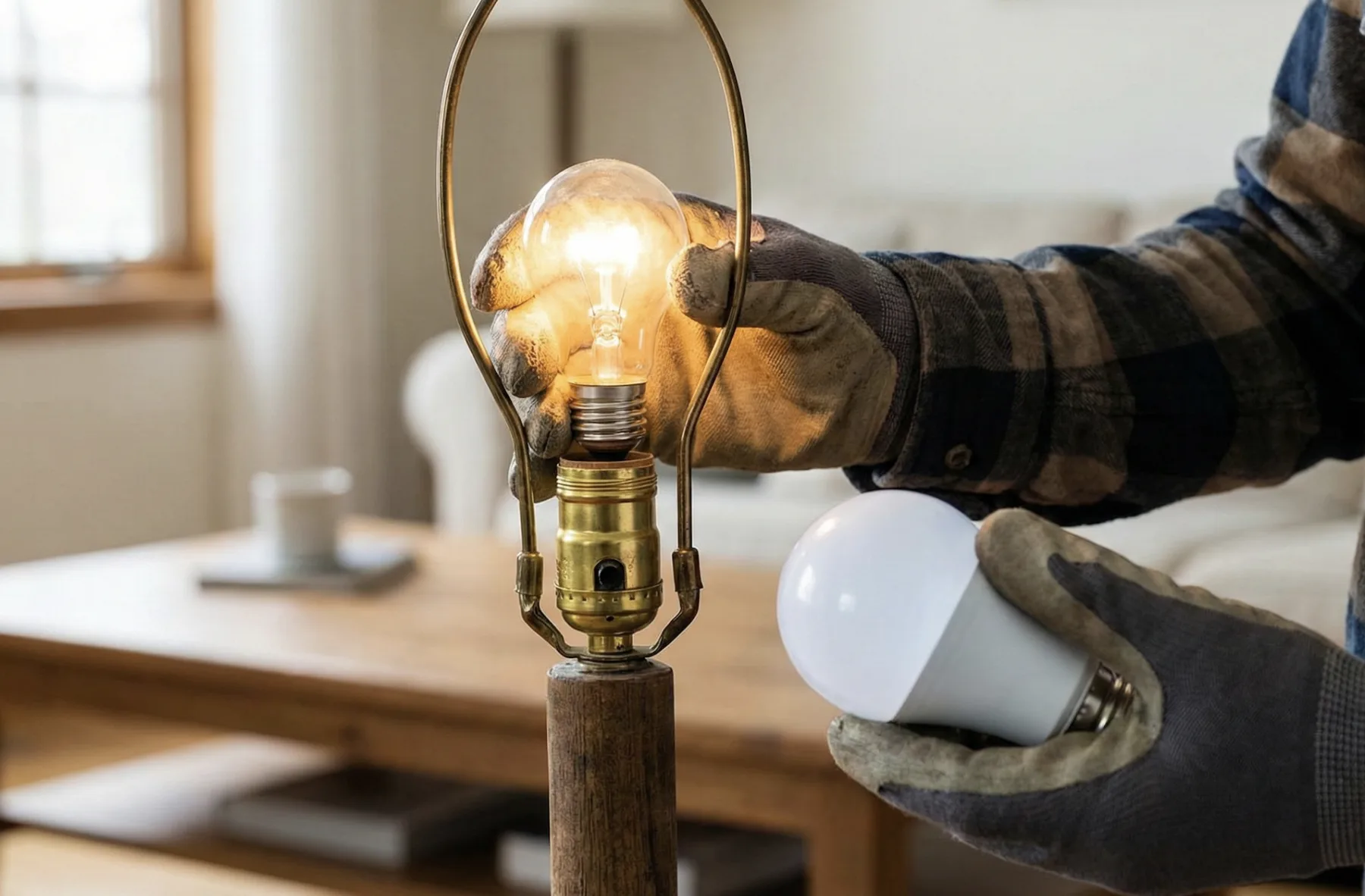
Last week, while helping my grandma change a few ancient light bulbs, I started wondering: if the old light bulbs still work, are they actually worth replacing? We all know LED bulbs use far less electricity, but should you rather wait until the old bulb breaks, or replace it immediately?
This guide walks you through the logic, gives you real-life examples, and lets you calculate your payback time with an interactive savings calculator.
Why Switching from Incandescent to LED Saves Energy (and Money)
Old incandescent and halogen bulbs are energy hogs. A classic 60-watt incandescent uses ten times more energy than a modern 6-watt LED, while providing the same brightness!
At the current EU average electricity price (~€0.30 per kWh), a single 60 W bulb used three hours a day costs roughly €20 per year to power.
Switching to a 6 W LED reduces that to just €2 per year — saving about €18 annually per bulb.
Multiply that across several rooms, and the numbers get big fast.
LED vs Incandescent: Energy Use and Cost Comparison
General Rule of Thumb: The greater the wattage drop, the quicker the payback. If your payback time is under one year, it’s almost always worth switching now.
| Example Swap | Annual Savings* | Payback (if new bulb €5) |
|---|---|---|
| 60 W → 6 W | ~€17.74 | ~3 months |
| 40 W → 5 W | ~€12.30 | ~5 months |
| 12 W → 5 W | ~€2.30 | ~3 years |
*Assumes €0.30 /kWh and 3 hours per day of use.
If it’s several years, replace the bulb once it fails — or focus on your most-used lamps first.
What to Consider Before Replacing Bulbs
- Hours of use: Focus on lamps you switch on every evening.
- Electricity price: Prices vary — Germany and Italy are higher than France or Poland.
- Brightness (lumens): Always match brightness, not wattage. A 60 W incandescent ≈ 800 lumens.
- Quantity: Replacing multiple bulbs multiplies savings, and buying bulbs in bulk might save you some money on top.
- CO₂ factor: Every kWh saved avoids ~0.19 kg CO₂ on average in the EU1.
If you are not sure how to find out how much energy your current light bulbs are consuming, don’t worry! Here is a quick guide on how to check the energy consumption of your light bulb.
Yearly cost ≈ (Wattage ÷ 1000) × hours per day × 365 × electricity price (€/kWh)
For example, a 60 W bulb used 3 hours per day at €0.30/kWh:
- Power: 60 W = 0.06 kW
- Yearly energy: 0.06 kW x 3 h x 365 = 65.7 kWh
- Cost: 65.7 kWh x 0.30€ = 19.71 €
If you want to calculate your bulb’s electricity cost, I have programmed a little LED payback calculator here:
LED Payback Calculator
Disclaimer: This is an estimate. Real savings depend on your exact tariff and how often you really use the lamp.
Real-Life Example: Changing My Grandma’s Bulbs
At my grandma’s place, we swapped four 60 W incandescents for €5 LEDs.
Her electricity price is around €0.32 /kWh, and she uses those lamps 4 hours a day.
Here’s what happened:
- Power drop per bulb: 54 W
- Yearly use: 1,460 hours
- Annual savings per bulb: ~€25
- Total savings for 4 bulbs: ~€100 per year
- Payback: < 3 months
That’s money she’ll keep saving every year — and it is even better for the environment.
The Environmental Bonus
Saving energy isn’t just good for your wallet — it also reduces carbon emissions.
The U.S. Department of Energy (DOE) conducted a life-cycle study in which they represented 20 million lumen-hours of light output to compare incandescent, CFL, and LED lamps2. Their results show that LEDs have the lowest environmental impact across nearly all categories. For air-related impacts, especially global warming potential, LEDs produce dramatically less CO₂-equivalent emissions than incandescent lamps—1031.64 kg CO₂-eq for incandescent vs. 122.77 kg for LEDs—over the same light output. Land-use impacts are also substantially lower for LEDs, and water-related environmental burdens (such as acidification and eutrophication potential) are markedly reduced compared to incandescent lamps. Overall, the study concludes that LED technology offers major environmental advantages across air, land, and water impact categories, largely due to its far lower energy consumption during use.
Importantly, the DOE study also shows that around 90% of a lamp’s total environmental impact comes from electricity use over its lifetime, not from manufacturing. While producing a modern LED bulb does require more materials and energy upfront—typically resulting in roughly 2–5 kg of CO₂-equivalent emissions per bulb, mainly from aluminum and electronics—this initial footprint is usually offset within a few months of operation thanks to the LED’s much lower power consumption.
Let’s do a little math, just for fun. If we assume we have a 60 W lamp burning an average of 3 hours per day, that is 1095 hours per year. At 60 watts, we consume 65.7 kWh of electricity per year. At an average greenhouse gas emission intensity of 0.187 kgCO₂e/kWh in Europe, we emit 12.3 kg of CO₂ that way per year. Using a 6-watt LED instead cuts that down to 1.23 kg of CO₂, reducing emissions by 11.07 kg of CO₂ per year — and that’s just for this single bulb!
Quick answers
- Replacing a 60 W bulb with a 6 W LED saves ~€18/year
- LEDs last 10–15 years with normal use
- Always compare lumens, not watts
- Incandescent → LED: cuts several kg CO₂ per year, even taking into account the production of the new bulb
- Biggest savings come from lamps used daily
Bottom Line
- Big wattage drop + frequent use → replace now
- Small wattage difference or rarely used lamp → wait
If in doubt, use the calculator above — it gives you a clear answer in seconds!
I hope you enjoyed reading this article. As a new blogger, I am happy for any support or constructive feedback, just reach out to me via the contact form! Thanks for reading Fix and Function!